.jpg)
Why I Want the New Packaging Rules to Be Even Stricter

Earlier this year a lot of people in food packaging were bracing for January 2026. That was the compliance deadline for the FDA's food traceability rule, FSMA 204, and the whole supply chain was scrambling to be ready.
Then it moved. The FDA pushed the deadline out by 30 months, to July 2028, and the US Congress went further and blocked enforcement before that date. The fire everyone was running toward was quietly rescheduled.
I found the reaction more interesting than the rule itself. Relief. A lot of companies exhaled and put the whole thing back on the shelf.
That reaction is exactly the problem. And it is why I am going to say something most people in my industry will not like.
I am not dreading the new wave of packaging and sustainability regulation. I want it to be stricter, and I want it to come faster.
Let me explain, because this is not idealism. It is strategy.
Rules raise the floor, and a higher floor is a moat
Every regulation that raises the standard for packaging does the same thing. It raises the cost and the capability required to stay in the market.
In my business we compete every day against small shops that win on one thing, a lower price. They can quote lower because they carry less. No environmental certification. No material testing. No investment in understanding what a substrate does after it leaves the door.
For years that price gap has been my problem. When standards are loose, a low price and a low capability look almost the same to a customer, and the more careful supplier only looks expensive. Regulation turns that into my advantage. This is not about wanting fewer competitors. It is about wanting the market to distinguish between a low price and a low capability.
A shop that survives purely on being cheap cannot suddenly produce recyclable structures, document substances of concern, or prove compliance for an export market. The rules ask for precisely the things a cut-price operation chose not to build. So every time the standard goes up, a layer of cheap competition falls away, and the customers who relied on it have to go find someone who was ready.
I would rather be the one who was ready. That is why stricter is better for me, not worse.
If you export, the EU packaging rules are not a European problem. They are yours.
This is the part I most want manufacturers and brand owners to hear, because I think many of us are making a quiet and dangerous assumption.
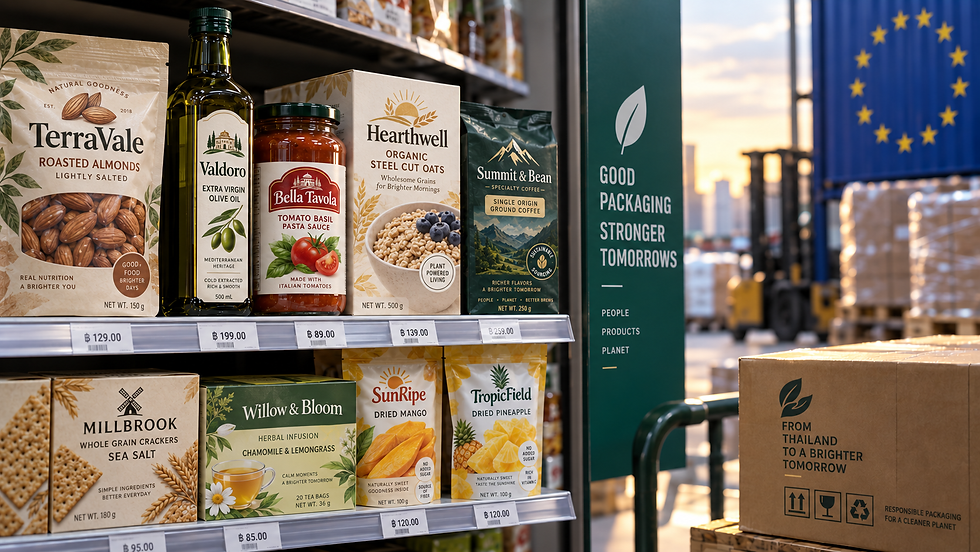
The EU's Packaging and Packaging Waste Regulation, the PPWR, began to apply on 12 August 2026. It does not care where your factory sits. It applies to any packaging placed on the EU market, which means it applies to the box, the label, and the container your product travels in, printed in Thailand or anywhere else.
The first requirements have already taken effect, including restrictions on certain substances of concern and on PFAS in food-contact packaging. From 2030, only packaging that meets defined recyclability grades will be allowed on the shelf, and by 2038 the bar rises again. These are not distant dates for a compliance officer to think about later. They are the specifications your European customer will start writing into purchase orders now.
I have heard too many people treat this as "a European thing." It is not. It is a filter on who gets to keep selling into one of the richest markets in the world. The companies that treat it as someone else's problem are the ones who will be told, politely, that their packaging no longer qualifies.
Stricter rules also expose the fakes
Here is where I will make my own industry uncomfortable a second time.
A tougher standard is not only bad news for the cheap. It is also bad news for the fake.
The market is full of materials sold as biodegradable, compostable, or sustainable, backed by a confident logo on a supplier's brochure. We test materials in our own plant before we put a customer's name on them, and a meaningful share of what is marketed as green does not behave the way the marketing promises.
One case stays with me. A supplier offered us a recyclable material, and the word "recyclable" did the selling. But a label does not get recycled alone. It goes onto a container, and the two have to be compatible for the whole package to actually be recovered. The face stock and adhesive combination they proposed risked contaminating the recycling stream of the very bottle it was meant to make greener. Each part was recyclable on its own. Together they were not. That distinction does not appear in a sales presentation. It appears when someone thinks about the finished package, not just the roll.
This is exactly the kind of thing a serious recyclability standard forces into the open. Loose rules let everyone make the same green claim. Strict rules, the kind that demand proof, separate the material that performs from the material that only markets well. I am fine with that. I would rather sell something I have tested than something I have only been told about.
The delay is time, not a reprieve
So back to FSMA 204 slipping to 2028, and to the long, phased rollout of the PPWR.
The wrong lesson is "good, we can relax." The right lesson is that the direction never reverses. Deadlines slip. The destination does not. Every one of these rules is moving the same way, toward more proof, more traceability, and more accountability for what a package is made of and what becomes of it afterward.
The extra time is not a pardon. It is a head start, and head starts only help the people who use them.
If you are a brand that exports, this is the moment to stop choosing a packaging supplier on price alone and start choosing on whether they can carry you across these lines at all. If you are a printer, this is the moment to build the capability while there is still slack in the schedule, instead of scrambling at a deadline that will feel very different the day it stops moving.
The rules everyone is complaining about are going to quietly decide who is still selling into these markets in ten years.
I know which side of that line I intend to be on. The only real question is how many of us choose to get there before we are forced to.
