.jpg)
Has Packaging Innovation Hit a Ceiling? A View from Bangkok's Factory Floor

Updated: Jul 10
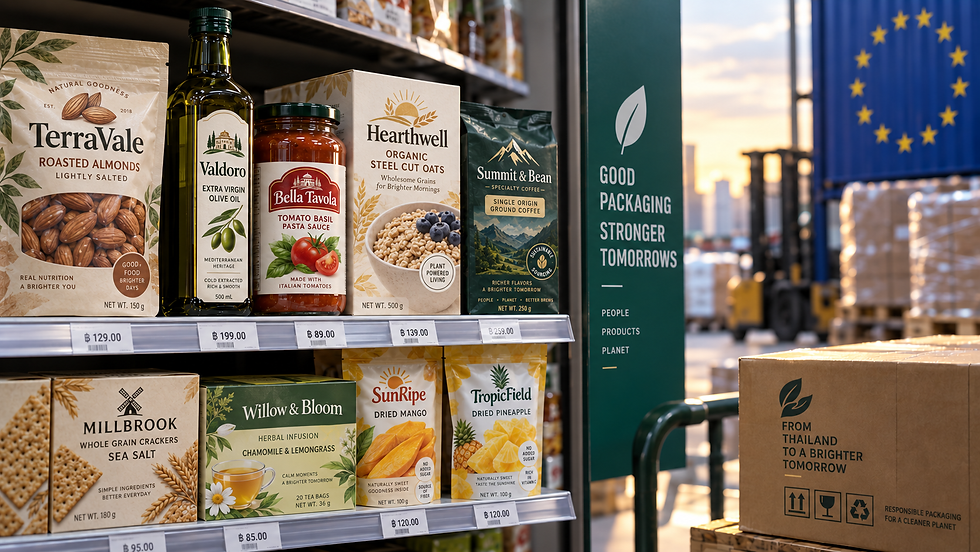
Walk through a supermarket in Bangkok, Tokyo, or Frankfurt and it's easy to come away with the same impression: packaging doesn't seem to be changing much anymore.
Bottles still look like bottles. Boxes are still boxes. Flexible pouches have become so common that even "new" products often feel like old products wearing different graphics.
People outside the industry sometimes ask if packaging innovation has run out of ideas.
The answer is no.
But I also understand why it feels that way.
The biggest changes in packaging today are happening in places consumers never notice.

Why Everything Looks the Same
I don't think the industry has become less innovative. I think innovation has changed direction.
Ten or fifteen years ago, companies competed by putting something visibly different on the shelf. Today, much of the engineering effort goes into solving problems that are almost invisible once the product reaches the consumer.
Take sustainability.
I've noticed the conversation with customers has changed too. Ten years ago, most discussions started with cost reduction. Today, recyclability usually comes up before price. That shift alone tells you where innovation effort is going. We've been through that ourselves. It's not unusual to spend months qualifying a material change that, once it reaches the shelf, looks almost identical to what came before.
Then the product reaches the supermarket.
To most shoppers, it looks exactly the same.
That's the strange reality of packaging today. Some of the hardest engineering work produces almost nothing you can actually see.
There's also an economic reason visible innovation has slowed.
A new package isn't just a new shape. It usually means new tooling, changes to filling equipment, adjustments to logistics, retailer acceptance, and higher costs. In today's market, that's a difficult investment to justify unless the commercial upside is obvious.
Most brands would rather improve what already works than gamble on something completely different.
I don't see that as a lack of creativity. It's simply where the economics are pushing the industry.
There's another point that's easy to overlook.
Formats like aluminum cans, PET bottles, corrugated boxes, and flexible pouches have been refined for decades. Every generation has made them lighter, cheaper, stronger, faster to produce, or easier to transport.
When a design has been optimized for that long, replacing it becomes incredibly difficult. A new idea can't just be slightly better. It has to be dramatically better.
That's a very high bar.
Where Innovation Actually Is
From where I sit, three areas are changing packaging far more than consumers realize.
The first is materials.
Mono-material packaging gets most of the attention, but it's only one part of a much bigger shift. Barrier coatings are improving. Wash-off adhesives are making PET recycling more effective. Linerless labels are reducing waste. Bio-based materials are gradually becoming commercially practical instead of remaining laboratory projects.
None of this makes for exciting photographs.
All of it matters.
The second change is data.
Packaging is becoming part of a much larger digital system. QR codes, serialization, digital product passports, traceability, and authentication are gradually turning every package into an information carrier, not just a container.
That's a bigger change than most people appreciate.
The third area is manufacturing itself.
Working in a factory, I probably pay more attention to process than most people do.
Inspection systems now catch defects that operators simply can't see consistently.
Color management has become far more precise. Faster changeovers make shorter production runs commercially realistic. Variable data printing that once felt specialized is becoming routine.
Consumers rarely notice these improvements.
Our customers certainly do.
If you're supplying automotive, electronics, medical devices, or other industries where labeling errors can stop an entire production line, process capability isn't a nice extra. It's the product.
The S-Curve Everyone Is Looking At
People often describe technology as moving through an S-curve.
I think packaging is a good example.
The visible part of packaging, the shapes people see on shelves, is approaching maturity. That's probably why it feels as though progress has slowed.
But that doesn't mean the industry has stopped moving.
It just means the next wave isn't about shape anymore.
It's about materials.
It's about information.
It's about manufacturing precision.
Those curves are still climbing.
What I'd Ask a Packaging Supplier Today
If I were choosing a packaging supplier today, I wouldn't start by asking what new formats they've invented.
I'd ask different questions.
Can they consistently run newer mono-material constructions at production scale?
Can they manage serialization and variable data without slowing production?
How often do they miss delivery dates?
What's their actual defect rate?
Can they demonstrate the environmental claims they're making?
Most importantly, I'd visit the factory.
We've hosted many customer visits over the years, and I've noticed something interesting. People often arrive wanting to discuss product specifications. After spending a couple of hours on the production floor, the conversation usually changes.
They start asking about inspection systems, process controls, lead times, and quality management instead.
Seeing the factory answers questions that brochures never can.
So Has Packaging Innovation Hit a Ceiling?
I don't think so.
I think we've simply been looking in the wrong place.
If your definition of innovation is a package that looks radically different on the shelf, then yes, progress has slowed.
But if innovation means making packaging easier to recycle, easier to trace, more reliable to manufacture, and better integrated into increasingly demanding supply chains, then this is one of the most interesting periods I've seen in the industry.
It just doesn't photograph particularly well.